What is step flashing?
Last updated · Roof anatomy
Short answer: Step flashing is a series of small L-shaped metal pieces installed where a sloped roof runs alongside a vertical wall, such as a dormer side or a second-story wall. One piece goes in with each shingle course, overlapping the piece below like steps, so water is handed down the roof instead of running behind the siding.[1]
How does step flashing work?
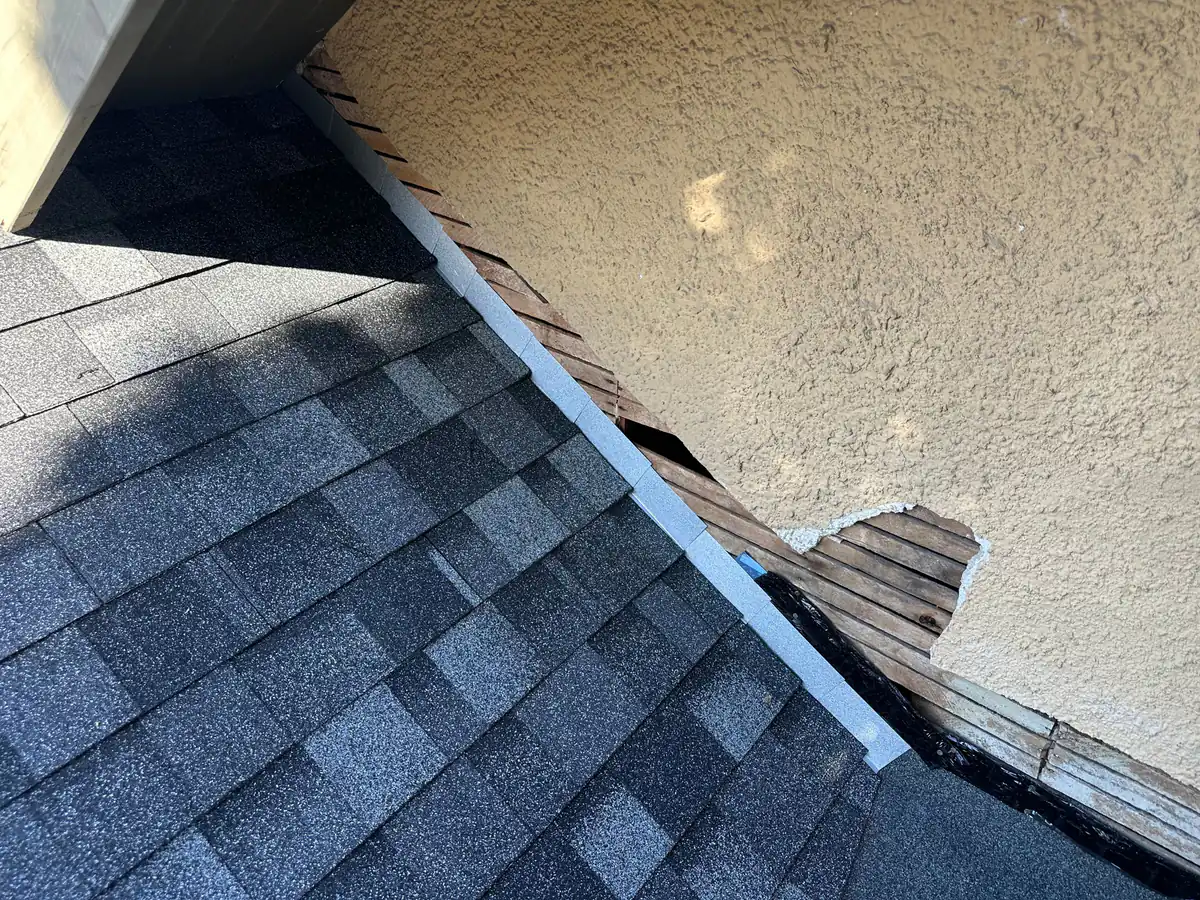
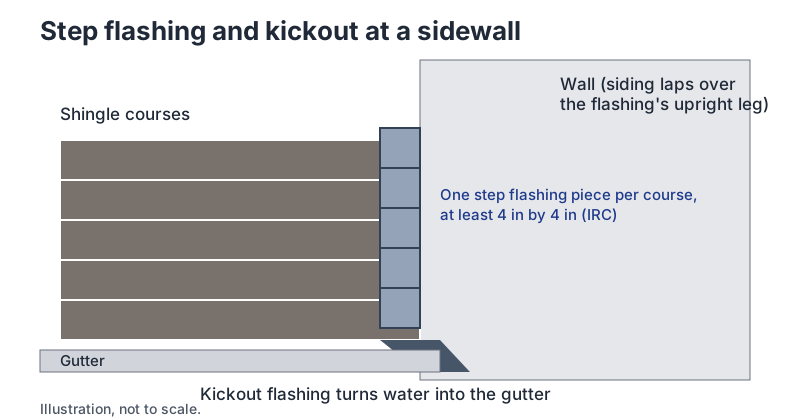
Step flashing works by overlapping. Each piece has one leg lying flat on the roof, under a shingle, and one leg standing up against the wall. The next course of shingles covers the flat leg, and the next piece of step flashing sits on top of that shingle and laps over the piece below. Water that runs along the wall lands on the top piece, flows onto a shingle, and continues down the roof. Because the pieces are separate, the roof and wall can move without tearing a long seam.
What does the residential code require for sidewall flashing?
The International Residential Code requires sidewall flashing by the step-flashing method on asphalt shingle roofs where the roof meets a vertical wall. Each piece must be at least 4 inches high and 4 inches wide, placed so it is covered by the shingle course above.[1] Separately, the wall covering rules require flashing at wall and roof intersections so water is directed to the exterior.[2] In practice, many roofers use pieces larger than the minimum, such as 5 by 7 or 4 by 8 inches, for extra overlap.
Why can't one long piece replace step flashing?
One long L-shaped piece seems a simpler way to replace step flashing, but water running down the roof gets behind its upper edge or along the top of each shingle and has nowhere to go but under the strip. Long strips also need to be nailed to both the roof and wall, which locks the two together. Step flashing avoids both problems. Continuous flashing is used where the top of a roof meets a wall, called headwall or apron flashing, because water there flows straight across it.
What is kickout flashing and why does it matter?
Kickout flashing is a bent piece at the bottom of a roof-to-wall junction, where the roof edge ends but the wall continues down. Without it, the last step flashing dumps water against the wall, where it runs behind the siding, rots sheathing, and stains the wall below. Kickouts are cheap and quick to install during a reroof. Inspectors flag missing kickouts frequently because the damage often hides behind siding until it is extensive.[3]
What are common step flashing mistakes?
The most common step flashing mistakes are: - Reusing old step flashing that is bent or full of nail holes. - Nailing the vertical leg to the wall, or nailing the flat leg too close to the bend. - Siding installed tight against the shingles, so it wicks water. - House wrap installed behind the flashing instead of lapping over it. - Sealant used in place of laps. - No kickout at the bottom.
Does siding need to come off for new step flashing?
Often, a little. The vertical leg of step flashing should sit behind the siding and its weather-resistive barrier, so a proper reflash means loosening or removing the lowest course of siding along the wall. With stucco or brick, the roofer may use counterflashing over the step flashing instead. Ask how the contractor plans to get behind your wall covering and who pays for siding repair or touch-up paint.
What should you ask a roofer about step flashing?
Ask whether step flashing will be replaced at every wall, what metal and size they use, whether kickouts are included, and how siding will be handled. Request photos of the flashing before the shingles cover it. Leaks at sidewalls often show up as stains on interior walls below the junction, so a careful answer here can save drywall and framing repairs later.
Rather talk to someone? Request a callback
Leave your name and number and a local roofing contractor will call you back about a free estimate and inspection. Available to homeowners in our service markets.
- A local contractor calls you. They confirm your address and a time that works.
- They inspect your roof. Free, in person, no obligation.
- You get a written price. You decide. No pressure.
Frequently asked questions
Can step flashing be reused?
Sometimes, if it is undamaged and fits the new shingles, but many roofers replace it as standard. The bid should say which.
Where does kickout flashing go?
At the bottom end of a roof-to-wall joint, where the roof edge stops and the wall continues downward.
Is step flashing needed for metal roofs?
Metal roofs use their own sidewall trims designed by the panel maker instead of shingle-style step flashing.
See 2026 roof replacement cost in your city →
Sources
- 2021 International Residential Code, Chapter 9: Roof Assemblies. codes.iccsafe.org/content/IRC2021P2/chapter-9-roof-assemblies
- 2021 International Residential Code, Chapter 3: Building Planning. codes.iccsafe.org/content/IRC2021P2/chapter-3-building-planning
- InterNACHI: Roof Inspection. www.nachi.org/roof-inspection.htm
Sources checked November 4, 2026. Estimates are not quotes. Roofing, insurance, and legal details vary. Confirm with your contractor, insurer, or attorney.