What is a soffit on a house?
Last updated · Roof anatomy
Short answer: A soffit is the finished panel on the underside of the roof overhang, running from the outside wall to the fascia board at the eave. Vented soffits are where most attics take in fresh air, so a soffit is part of the ventilation system as well as trim. Common materials are vinyl, aluminum, fiber cement, and painted wood.[1]
Where is the soffit, and how is it different from the fascia?
Stand under the eave and look up: the flat surface between the wall and the outer edge of the roof is the soffit. The vertical board facing outward at the very edge, where the gutter usually hangs, is the fascia. Together with the drip edge on top, they make up the eave trim. Houses with no overhang, a style common on some contemporary and older urban homes, have little or no soffit, which limits where intake ventilation can go.
Why do vented soffits matter for the roof?
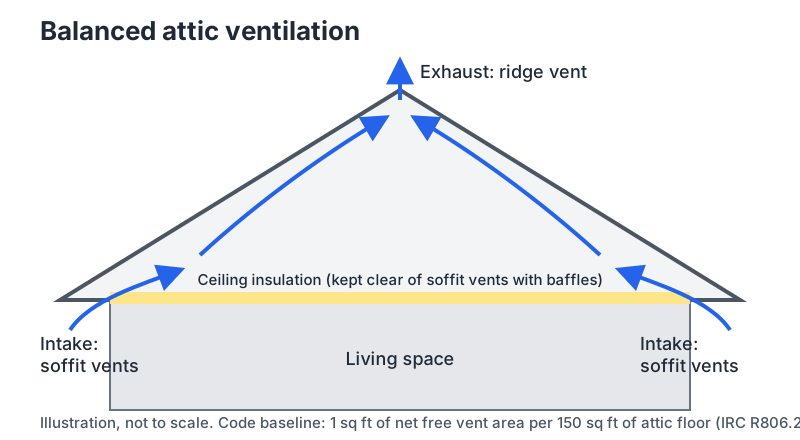
Most passive attic ventilation designs pull outside air in low at the soffits and let it out high at a ridge vent or roof vents. The residential code sets the minimum vent area in Section R806.2 and requires vent openings to be screened with corrosion-resistant mesh with openings between 1/16 and 1/4 inch.[1] Roofing manufacturers recommend at least as much intake as exhaust, and much of that intake comes from soffit panels.[2] A solid soffit with no vents, or a vented soffit blocked by insulation, can leave the attic hot in summer and damp in winter.
What are soffits made of?
- Vinyl: inexpensive, does not rot, and comes in vented and solid panels; it can sag or warp near heat sources. - Aluminum: durable and fire-resistant, common in retrofit wraps over old wood. - Fiber cement: rigid and fire-resistant, popular where wildfire codes apply. - Wood: traditional, easy to repair, but must be kept painted or it rots. Material life expectancy charts used by home inspectors show wide ranges for soffit and fascia depending on material and upkeep.[3]
What causes soffit damage?
Water is the usual culprit. Overflowing gutters, missing drip edge, or ice dams push water behind the fascia and into the soffit, where it rots wood and stains paint. Birds, squirrels, and bees take advantage of loose panels or rotted corners. In attics with too little ventilation, warm moist air can also condense on the back of the soffit. A soffit stain right below a valley or roof-to-wall corner usually points to a roof or flashing problem above, not a soffit problem.
Is soffit repair part of a roof replacement?
Not automatically. Many roofing bids stop at the drip edge, while gutter and siding contractors handle soffit and fascia. However, a roofer who is adding a ridge vent may need to add soffit intake to make it work, and rotted fascia found during tear-off often has to be replaced before new drip edge and gutters go on. Ask whether soffit and fascia repairs are priced per foot and whether they will be painted or wrapped. Ballpark pricing varies with material and access, so get it itemized.
How can you tell if your soffits are vented?
Look for perforated panels, slotted strips, or round plug vents in the soffit. Then check from the attic side with a flashlight: you should see daylight or vent baffles at the eaves, not a wall of insulation. If insulation is packed against the roof deck there, ask your roofer or insulation contractor to install baffles so air can pass.
What should you ask a contractor about soffits?
Ask whether the existing soffits provide enough intake for the planned exhaust, what material any new soffit will be, how rotted wood behind it will be handled and priced, and whether the job includes baffles. Getting these answers from the contractor before the roof is torn off avoids change orders later, and it tells you whether the soffit work is in the roofer's scope or needs a separate gutter or siding contractor.
Rather talk to someone? Request a callback
Leave your name and number and a local roofing contractor will call you back about a free estimate and inspection. Available to homeowners in our service markets.
- A local contractor calls you. They confirm your address and a time that works.
- They inspect your roof. Free, in person, no obligation.
- You get a written price. You decide. No pressure.
Frequently asked questions
Can soffit vents let rain or snow into the attic?
Rarely, because they face down and are sheltered by the overhang. Wind-driven snow can enter poorly designed vents, which is why baffled, screened vents are used.
Should I paint over vented soffit?
Avoid paint that clogs the perforations. Blocked vents reduce the airflow the attic depends on.
Is soffit the same as eave?
The eave is the whole lower edge of the roof that overhangs the wall. The soffit is the panel on its underside.
See 2026 roof replacement cost in your city →
Sources
- 2021 International Residential Code, Chapter 8: Roof-Ceiling Construction. codes.iccsafe.org/content/IRC2021P2/chapter-8-roof-ceiling-construction
- ARMA: Attic Ventilation Best Practices for Steep-Slope Asphalt Shingle Roofs. www.asphaltroofing.org/attic-ventilation-best-practices-steep-slope-asphalt-shin
- InterNACHI, Standard Estimated Life Expectancy Chart. www.nachi.org/life-expectancy.htm
Sources checked November 4, 2026. Estimates are not quotes. Roofing, insurance, and legal details vary. Confirm with your contractor, insurer, or attorney.