What is counter flashing?
Last updated · Roof anatomy
Short answer: Counterflashing is a piece of metal attached to a wall or chimney that laps down over the base flashing or step flashing on the roof. The base flashing turns up the wall; the counterflashing covers its top edge so water cannot run behind it. Together they let the roof and the wall move separately without opening a leak.[1]
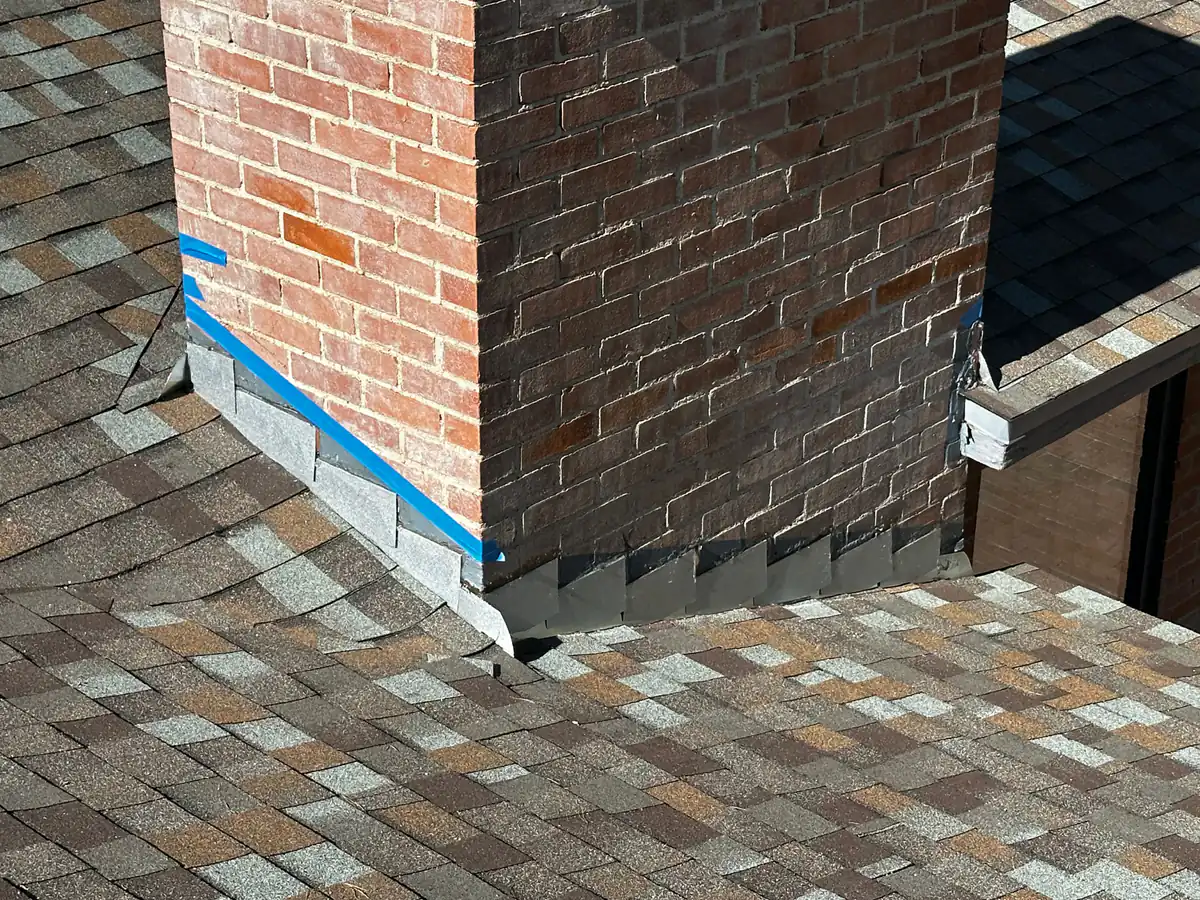
How does counterflashing work with base flashing?
Counterflashing never works alone. Where a roof meets a vertical surface, base or step flashing lies on the roof and turns up the wall a few inches. If nothing covered the top of that upturned leg, water running down the wall would get behind it. Counterflashing is fastened to the wall above and hangs down over the upturned leg, like a shingle on a wall. Because the two pieces are separate, the roof deck can expand, shrink, and settle without tearing the seal, which a single rigid piece could not do.
Where is counterflashing used?
Counterflashing is most familiar on masonry chimneys, but it also appears where a roof meets a brick or stucco wall, at parapet walls on flat roofs, around curb-mounted skylights and rooftop equipment, and at some dormer walls. On walls with lap siding, the siding and house wrap usually act as the counterflashing over step flashing, so you will not see a separate metal piece there. The residential code's flashing section requires base and cap (counter) flashing installed per the manufacturer's instructions, with metal of minimum thickness specified.[1]
How is counterflashing attached to a chimney?
There are two common ways counterflashing is attached to a brick chimney: - Reglet (cut-in): a mason or roofer grinds a slot into a mortar joint, inserts the bent top edge of the counterflashing, and seals it with mortar or sealant. On sloped roofs, counterflashing is often stepped to follow the mortar joints. - Surface-mounted: a termination bar or flashing is fastened to the face of the masonry and sealed along the top edge. This is quicker but depends heavily on sealant, which needs maintenance. Professional detailing guidance from the National Roofing Contractors Association favors set-in counterflashing for long-term performance.[3]
What are signs of counterflashing failure?
Most counterflashing failures are visible from the ground or the attic: - Counterflashing pulled out of the mortar joint or hanging loose. - Sealant along the top edge cracked, missing, or smeared over multiple times. - Rust holes in old steel flashing. - Water stains on the ceiling or attic framing around the chimney, especially after wind-driven rain. Inspectors pay close attention to chimney and wall flashing for this reason.[2]
Should counterflashing be replaced during a reroof?
Often, yes. Base and step flashing are usually replaced with the shingles, and old counterflashing may not fit the new layer heights or may be too corroded to bend back. Lifting old counterflashing to slip new step flashing beneath it can crack the mortar joint. Many contractors replace counterflashing at chimneys as standard practice; others reuse it when it is in good shape. The bid should say which.
Who installs counterflashing, a roofer or a mason?
It depends on the method. Many roofing crews cut reglets and install counterflashing themselves. On chimneys with crumbling mortar or failing brick, a mason may need to repoint or rebuild part of the chimney first. Ask whether the roofing bid includes chimney work, and if not, who will coordinate it and in what order.
What should you ask about chimney and wall counterflashing?
Ask whether counterflashing is being replaced or reused, whether it will be cut in or surface-mounted, what metal will be used, and whether a cricket is needed behind the chimney. Request before-and-after photos of each chimney and wall junction. A leak traced to bad counterflashing years later is far cheaper to prevent now than to repair through a finished ceiling.
Rather talk to someone? Request a callback
Leave your name and number and a local roofing contractor will call you back about a free estimate and inspection. Available to homeowners in our service markets.
- A local contractor calls you. They confirm your address and a time that works.
- They inspect your roof. Free, in person, no obligation.
- You get a written price. You decide. No pressure.
Frequently asked questions
Is counterflashing the same as step flashing?
No. Step flashing lies on the roof under each shingle course. Counterflashing is attached to the wall and covers the top of the step or base flashing.
Can I just caulk my chimney flashing?
Sealant can buy time, but it breaks down in sun and weather. Properly set counterflashing is the lasting fix.
Does a stucco wall need counterflashing?
Roof-to-stucco junctions need flashing integrated with the wall's weather barrier, often with a separate counterflashing piece or a stucco stop.
See 2026 roof replacement cost in your city →
Sources
- 2021 International Residential Code, Chapter 9: Roof Assemblies. codes.iccsafe.org/content/IRC2021P2/chapter-9-roof-assemblies
- InterNACHI: Roof Inspection. www.nachi.org/roof-inspection.htm
- National Roofing Contractors Association. www.nrca.net/
Sources checked November 4, 2026. Estimates are not quotes. Roofing, insurance, and legal details vary. Confirm with your contractor, insurer, or attorney.