What is a roof valley?
Last updated · Roof anatomy
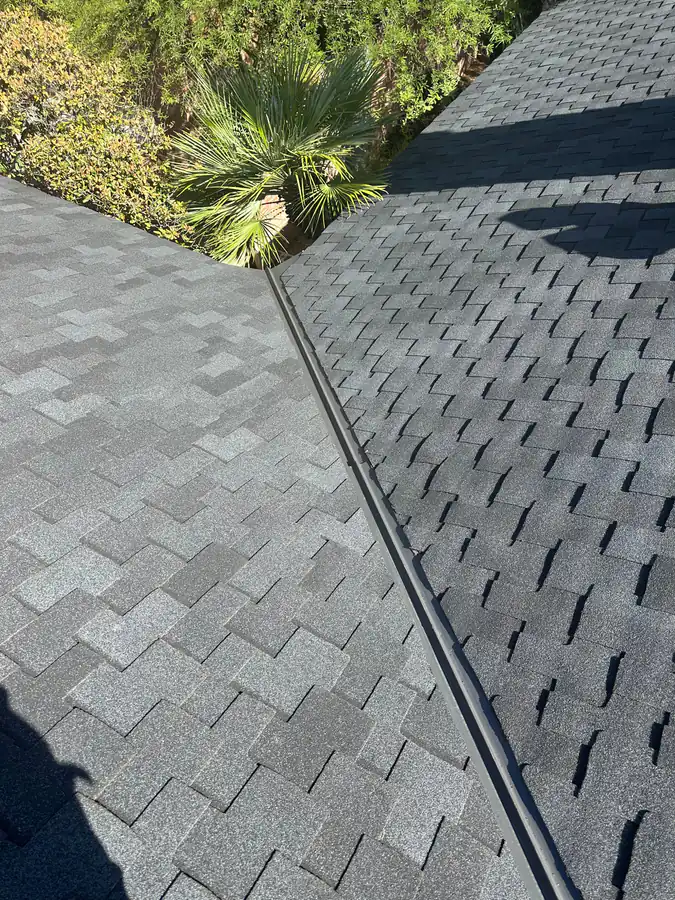
Short answer: A roof valley is the inward-sloping channel where two roof planes meet at an angle, such as where a garage roof joins the main house. Valleys collect water from both planes, so they carry more runoff than any other part of the roof. They are built as open metal valleys, closed-cut valleys, or woven valleys over a code-required lining.[1]
Where do valleys form on a roof?
Any time two sloped roof surfaces meet in a downward-pointing line, the meeting line is a valley. You will see valleys where an L-shaped house turns a corner, where a dormer or porch roof ties into the main roof, and on cross-gable designs. The opposite shape, an upward-pointing line where planes meet, is a hip. A complex roof with several wings can have more valley footage than a simple ranch, which adds labor and material to a replacement.
What are the main types of shingle valleys?
- Open valley: shingles stop short of the center line and a strip of corrosion-resistant metal is left exposed. Water runs fast on metal, and debris washes through easily. - Closed-cut valley: shingles from one side run across the valley, and shingles from the other side lap over them and are trimmed in a straight line a few inches from the center. - Woven valley: shingles from both sides are interlaced across the valley. This works with 3-tab shingles but is not recommended by many makers for thicker laminated shingles, which do not bend well. Shingle manufacturers each publish which valley methods they accept, and the warranty can depend on following them.
What does code require under a valley?
Section R905.2.8.2 of the International Residential Code sets valley lining rules for asphalt shingle roofs. For open valleys, the lining must be corrosion-resistant metal at least 24 inches wide, or specified layers of mineral-surfaced roll roofing. For closed valleys, the code allows several linings, including a strip of self-adhering polymer-modified bitumen membrane at least 36 inches wide.[1] Self-adhering membrane of this type is made to the ASTM D1970 standard, the same material used as ice barrier at eaves.[2] Many roofers line every valley with membrane whatever the climate.
Why do valleys leak?
Valleys handle concentrated water, and small mistakes get punished. Common causes include nails driven too close to the valley center, shingles trimmed without clipping the upper corner so water is steered under the course, missing or short lining, and debris dams of leaves or pine needles that push water sideways. In snowy climates, ice can build in valleys just as it does at eaves. Home inspectors are trained to look closely at valleys, flashings, and penetrations because that is where leaks start.[3]
How do you spot valley problems from the ground?
You can spot many valley problems from the ground. Look for granule wash or dark streaks running out of the valley, shingles that look curled or cracked along the trimmed edge, and a buildup of leaves at the bottom where the valley meets the gutter. Inside, stains on the ceiling near an inside corner of the house or along the wall below a valley are a warning sign. A gutter that overflows at the valley outlet during heavy rain may need a splash guard or larger downspout.
What should a roofing bid say about valleys?
A good bid lists the valley footage, the lining material and width, and the valley style. If you prefer the look of open metal valleys, ask for the metal type and gauge and whether it will be painted to match. If the existing roof has woven valleys and you are moving to laminated shingles, expect the contractor to switch to closed-cut or open valleys. Valley rework is labor-heavy, so ask whether it is included in the per-square price or added separately.
How do you maintain a roof valley?
Keep valleys clear of debris, especially under trees. Do not let anyone patch a valley leak with a smear of roofing cement on top of the shingles; that tends to trap water and hide the real problem. If one valley has failed on an otherwise sound roof, a roofer can often rebuild just that valley by lifting the shingles, relining it, and reinstalling or replacing the shingles on both sides.
Rather talk to someone? Request a callback
Leave your name and number and a local roofing contractor will call you back about a free estimate and inspection. Available to homeowners in our service markets.
- A local contractor calls you. They confirm your address and a time that works.
- They inspect your roof. Free, in person, no obligation.
- You get a written price. You decide. No pressure.
Frequently asked questions
Which valley type is best?
Each works when installed per the shingle maker's instructions. Open metal valleys shed water and debris fastest, and closed-cut valleys give a cleaner look with laminated shingles.
Can a valley be repaired without a new roof?
Often yes. A roofer can open up the valley, replace the lining, and reshingle both sides of it.
Why are there stains on my ceiling under a valley?
Valley leaks often come from nails too close to the center, debris dams, or failed lining. Have a roofer inspect it before more water damages the drywall.
See 2026 roof replacement cost in your city →
Sources
- 2021 International Residential Code, Chapter 9: Roof Assemblies. codes.iccsafe.org/content/IRC2021P2/chapter-9-roof-assemblies
- ASTM D1970: Self-Adhering Polymer Modified Bituminous Sheet for Ice Dam Protection. store.astm.org/d1970_d1970m-21.html
- InterNACHI: Roof Inspection. www.nachi.org/roof-inspection.htm
Sources checked November 4, 2026. Estimates are not quotes. Roofing, insurance, and legal details vary. Confirm with your contractor, insurer, or attorney.