Why do some codes require ice and water shield?
Last updated · Codes, permits & licensing
Short answer: Under the model 2021 IRC § R905.1.2, an ice barrier (often sold as "ice and water shield") is required only in areas your local code official has marked in Table R301.2 as having a history of ice forming along the eaves and backing up water. It is not a nationwide blanket rule.
What the IRC actually says
Where that designation exists, the ice barrier must:
- Be used for asphalt shingles, metal roof shingles, mineral-surfaced roll roofing, slate/slate-type shingles, wood shingles, and wood shakes;
- Consist of at least two layers of underlayment cemented together, or a self-adhering polymer-modified bitumen sheet (products that typically meet ASTM D1970);
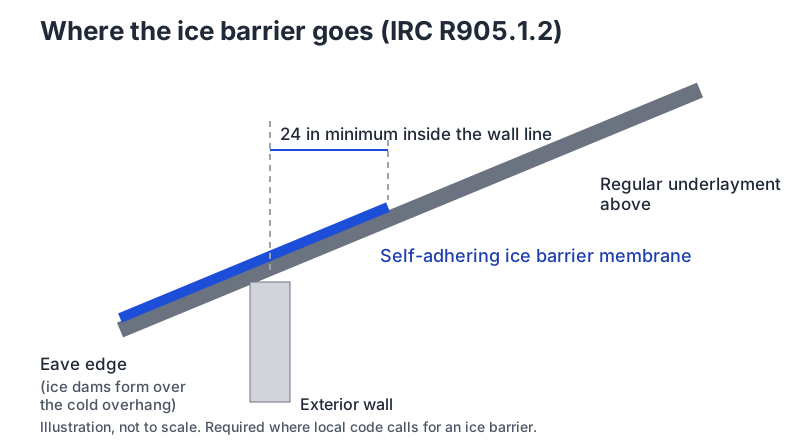
- Extend from the lowest edges of all roof surfaces to a point not less than 24 inches inside the exterior wall line;
- On roofs of 8:12 and steeper, also run not less than 36 inches along the slope from the eave edge (both minimums must be met).
Detached accessory structures with no conditioned floor area are generally excepted. Editions and local amendments differ — cite the edition your city or county adopted.
Why the rule exists
When snow melts on a warm roof deck and refreezes at a cold eave, an ice dam forms. Water ponds behind the dam and can be driven under shingles into the attic and wall. A sealed membrane at the eave is meant to keep that backed-up water out. Warm climates without ice-dam history (much of Arizona and Florida, for example) often do not designate the requirement — though manufacturers may still call for self-adhered membrane in valleys or at penetrations.
How to know if your town requires it
- Ask the building department whether Table R301.2 (or the local equivalent) lists ice barrier underlayment as required.
- Read the shingle manufacturer's installation instructions; IRC installation rules also point you to those instructions.
- Do not assume a neighboring city has the same answer.
Valleys are a separate conversation
The ice-barrier section is about eaves in designated ice-dam areas. Valley protection is governed by valley-lining rules and manufacturer instructions (self-adhered ASTM D1970 membrane is often permitted as a valley liner). Many quality installs use ice-and-water membrane in valleys even when the eave ice barrier is not code-required.
Local building codes vary. Always verify requirements with your local building department and follow the manufacturer's installation instructions for the products installed.
Rather talk to someone? Request a callback
Leave your name and number and a local roofing contractor will call you back about a free estimate and inspection. Available to homeowners in our service markets.
- A local contractor calls you. They confirm your address and a time that works.
- They inspect your roof. Free, in person, no obligation.
- You get a written price. You decide. No pressure.
Frequently asked questions
Is ice and water shield required everywhere?
No. Under IRC R905.1.2 it is required only where the local jurisdiction designates ice-dam history in its climatic design table.
How far up the roof must ice barrier go?
To a point at least 24 inches inside the exterior wall line, and on 8:12+ roofs also at least 36 inches along the slope from the eave.
Does Arizona or Florida require ice barrier by the IRC rule?
Many warm jurisdictions do not designate ice-dam areas. Confirm with the local building department; manufacturer instructions may still require self-adhered membrane in valleys or other details.
See 2026 roof replacement cost in your city →
Sources
- 2021 International Residential Code § R905.1.2 (Ice barrier). codes.iccsafe.org/
- ASTM D1970 (self-adhering polymer-modified bitumen underlayment). store.astm.org/standards/d1970
- Owens Corning Duration Series installation instructions (ice and water barrier guidance). www.owenscorning.com/
- FEMA guidance on ice dams and homeowner preparedness (general). www.fema.gov/
Sources checked November 4, 2026. Estimates are not quotes. Roofing, insurance, and legal details vary. Confirm with your contractor, insurer, or attorney.