What does ice and water shield do for my roofing system?
Last updated · Roof anatomy
Short answer: Ice and water shield is a self-adhering, waterproof membrane installed under the primary roof covering. It seals around nails and resists water that gets under shingles from ice dams or wind-driven rain at vulnerable details.
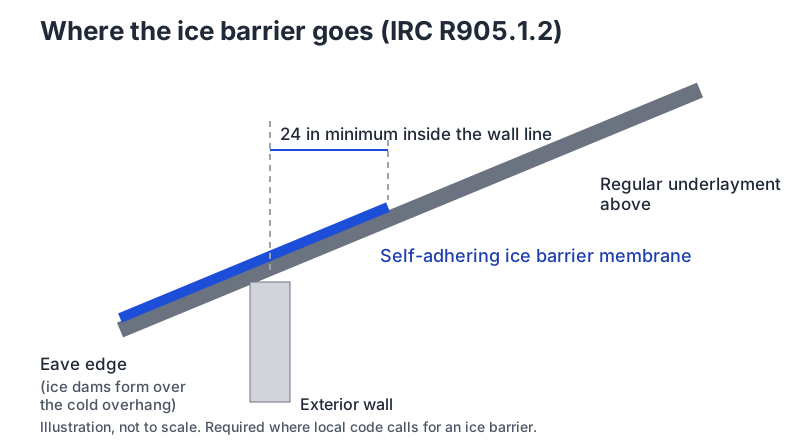
How it works
Unlike ordinary felt or many synthetic underlayments that shed water but can be pierced by fasteners, a self-adhered polymer-modified bitumen sheet (typically complying with ASTM D1970) sticks to the deck and seals around nail shanks. If water is forced under the shingles, the membrane is the backup.
Where it is commonly used
- Eaves in cold climates with ice-dam risk (and where code requires an ice barrier).
- Valleys, where two slopes concentrate water.
- Around penetrations — skylights, chimneys, sidewalls, and low-slope transitions — when the manufacturer or scope calls for it.
- Low-slope asphalt sections (often 2:12 to under 4:12), where double underlayment or self-adhered membrane is typical.
What it does not do
- It is not a substitute for a sound primary roof covering.
- Covering an entire roof with non-breathable self-adhered membrane without adequate attic ventilation can trap moisture; manufacturers warn about ventilation when membrane is used deck-wide.
- It does not fix active leaks from failed flashings by itself.
Brand names you may see
Trade names include products such as GAF WeatherWatch / StormGuard, Owens Corning WeatherLock, and CertainTeed WinterGuard. Ask for the product data sheet and ASTM D1970 compliance, not just a nickname.
Cold vs. hot climates
In Minnesota, Colorado, Wisconsin, and similar markets, eave ice barrier is often code-driven. In Phoenix or Tampa, ice dams are rare, but self-adhered membrane in valleys and at walls is still common best practice against wind-driven rain.
Local building codes vary. Always verify requirements with your local building department and follow the manufacturer's installation instructions for the products installed.
Rather talk to someone? Request a callback
Leave your name and number and a local roofing contractor will call you back about a free estimate and inspection. Available to homeowners in our service markets.
- A local contractor calls you. They confirm your address and a time that works.
- They inspect your roof. Free, in person, no obligation.
- You get a written price. You decide. No pressure.
Frequently asked questions
Is ice and water shield the same as underlayment?
It is a type of underlayment — a self-adhering waterproof sheet — used in place of or in addition to standard felt/synthetic in vulnerable areas.
Do I need it on the whole roof?
Usually not. Full-deck use is a design choice and needs proper ventilation. Code ice-barrier rules typically focus on eaves in designated areas.
Can I install shingles directly over it?
Yes when the product and shingle instructions allow it; follow both manufacturers' instructions for laps, primer, and temperature limits.
See 2026 roof replacement cost in your city →
Sources
- ASTM D1970 (self-adhering polymer-modified bitumen underlayment). store.astm.org/standards/d1970
- 2021 International Residential Code § R905.1.2 (Ice barrier). codes.iccsafe.org/
- GAF WeatherWatch / StormGuard product literature (self-adhered ice barrier). www.gaf.com/
- Owens Corning Duration Series installation instructions (ice and water barrier guidance). www.owenscorning.com/
- CertainTeed WinterGuard product literature. www.certainteed.com/
Sources checked November 4, 2026. Estimates are not quotes. Roofing, insurance, and legal details vary. Confirm with your contractor, insurer, or attorney.