Ice dams on roofs: Causes and prevention
Last updated · Maintenance
Short answer: Ice dams form when heat escaping from the house warms the roof deck, melting snow that then refreezes at the colder eaves. The ridge of ice traps more meltwater, which backs up under shingles and leaks inside. The lasting fix is air sealing and insulating the attic, with ventilation and an ice barrier membrane at the eaves as backup.[1]
What causes ice dams on a roof?
Ice dams on a roof are caused by uneven roof temperatures. Warm air from the living space leaks into the attic through gaps around light fixtures, attic hatches, plumbing stacks, and top plates. That heat warms the upper roof deck above freezing, so the bottom layer of snow melts even when the air outside is cold. Meltwater runs down to the eave, which sits over the cold overhang, and freezes there. Over several days the ice builds into a ridge, and new meltwater pools behind it.[1]
What damage can an ice dam do?
The damage an ice dam does comes from water that backs up behind the ice. Shingles shed water running downhill but are not built to hold standing water, so it seeps under them and through nail holes. Signs include stains on ceilings near exterior walls, peeling paint, wet insulation, and damp drywall at the top of walls. Heavy ice can also pull gutters loose. Wet insulation loses much of its value and can lead to mold if it stays damp.
How do you prevent ice dams for good?
You prevent ice dams for good by keeping the roof deck cold. That means stopping warm air from reaching the attic and keeping enough insulation on the attic floor. ENERGY STAR recommends sealing air leaks first and then adding insulation, since insulation alone does not stop air movement.[3] Common air-sealing targets are recessed lights, the attic hatch, gaps around chimneys (using fire-rated materials), and holes where wires and pipes pass through. Bathroom and kitchen fans should vent outdoors, not into the attic.
Does attic ventilation help with ice dams?
Attic ventilation helps by flushing out heat that does get into the attic, but it cannot make up for big air leaks or thin insulation. Balanced intake at the soffits and exhaust near the ridge keeps the underside of the deck closer to outdoor temperature. Baffles at the eaves keep insulation from blocking soffit vents. The diagram on this page shows the airflow path from intake to exhaust.
What does code require at the eaves?
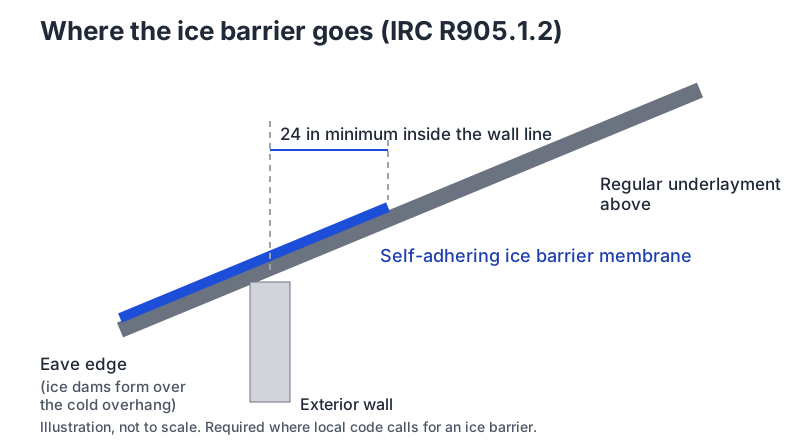
At the eaves, code requires an ice barrier in areas where there has been a history of ice forming along the eaves and causing a backup of water. Under the International Residential Code, the ice barrier must run from the lowest edge of the roof to at least 24 inches inside the exterior wall line of the building.[2] It is usually a self-adhering membrane that seals around nails. Local building departments decide whether the requirement applies in your area. The membrane is a backup layer that limits leaks; it does not stop ice dams from forming.
Do heat cables stop ice dams?
Heat cables can stop ice dams from forming in a specific spot by melting a channel through the ice so water can drain. They are a stopgap rather than a cure, since they treat the symptom and use electricity all winter. They work best on short trouble spots, such as a valley over an entry or a section of eave above a cathedral ceiling where insulation is hard to add. Install them per the maker's instructions, plug them into a GFCI-protected outlet, and keep them clear of combustible debris.
What should you do if an ice dam forms now?
If an ice dam forms now, focus on safe, gentle steps. From the ground, a long-handled roof rake can pull the first few feet of snow off the roof edge so less meltwater feeds the dam. Do not chip ice with a hammer or shovel, which damages shingles, and do not climb onto an icy roof. If water is coming inside, catch it, move valuables, and call a roofer or ice dam removal service that uses low-pressure steam. Our guide on what to do about an ice dam goes through the steps.
When should you call a professional?
Call a professional when you see interior leaks, when icicles and ice ridges return every winter, or when you plan a re-roof. An energy auditor or insulation contractor can find air leaks with a blower door test. A roofer can confirm the ice barrier at the eaves and check ventilation during an inspection. Fixing the attic first and the roof second solves the problem at its source.
Rather talk to someone? Request a callback
Leave your name and number and a local roofing contractor will call you back about a free estimate and inspection. Available to homeowners in our service markets.
- A local contractor calls you. They confirm your address and a time that works.
- They inspect your roof. Free, in person, no obligation.
- You get a written price. You decide. No pressure.
Frequently asked questions
Are icicles a sign of an ice dam?
Large icicles along the eaves often go with ice dams, since both come from meltwater refreezing at the roof edge.
Will more insulation alone stop ice dams?
Not always. Air leaks carry a lot of heat into the attic, so seal leaks first, then insulate.
Is it safe to use salt on an ice dam?
Rock salt can harm shingles, gutters, and plants. Calcium chloride products made for ice melting are gentler, but avoid climbing onto an icy roof to apply anything.
See 2026 roof replacement cost in your city →
Sources
- InterNACHI: Ice Dams. www.nachi.org/ice-dams.htm
- 2021 International Residential Code, Chapter 9: Roof Assemblies. codes.iccsafe.org/content/IRC2021P2/chapter-9-roof-assemblies
- ENERGY STAR: Seal and Insulate. www.energystar.gov/saveathome/seal_insulate
Sources checked November 4, 2026. Estimates are not quotes. Roofing, insurance, and legal details vary. Confirm with your contractor, insurer, or attorney.