What is roof decking (sheathing)?
Last updated · Roof anatomy
Short answer: Roof decking, also called sheathing, is the layer of plywood, OSB, or wood boards fastened to the rafters or trusses that everything else sits on. It carries the weight of the roofing, workers, and snow, and gives nails something to grip. Asphalt shingles must be installed over solid decking, so damaged boards are replaced during a reroof.[1]
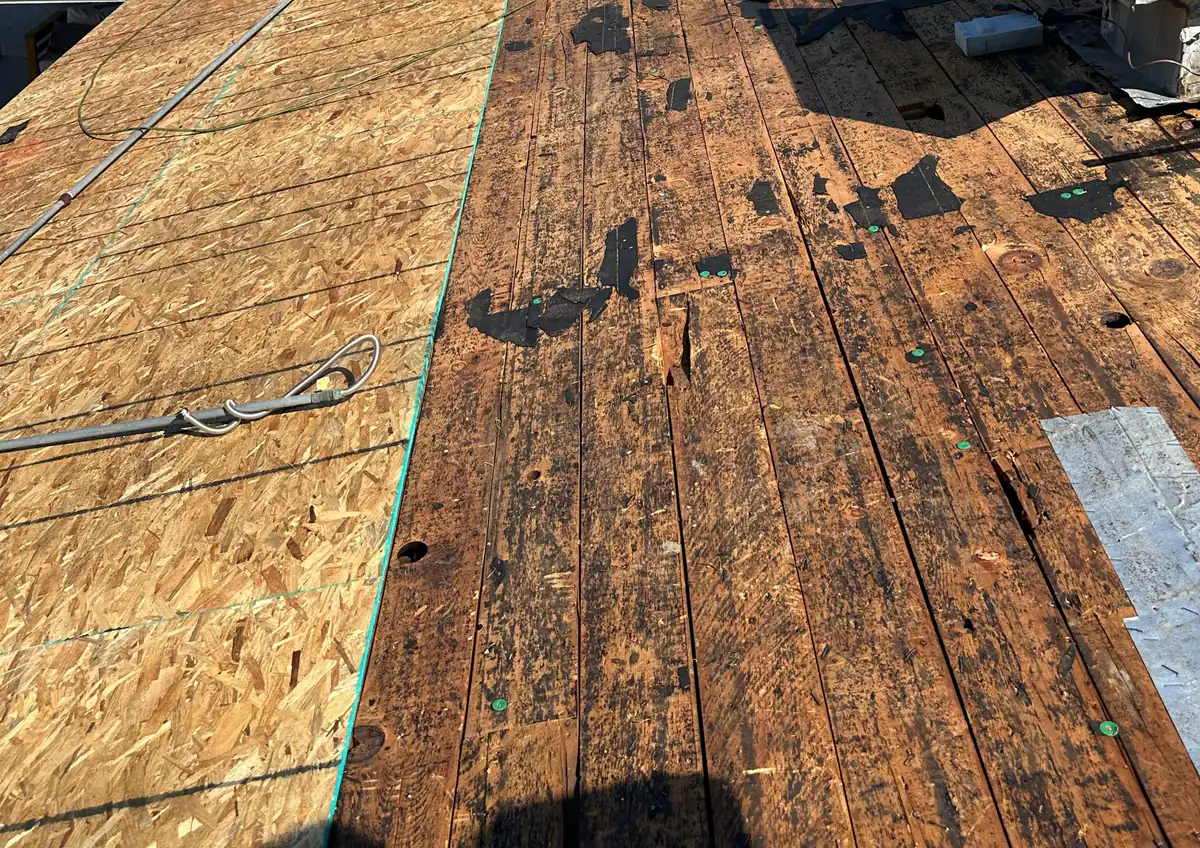
What materials are used for roof decking?
Most newer homes use oriented strand board (OSB) or plywood panels, usually 4 by 8 feet. Both are engineered wood products rated for roof use and stamped with a span rating that tells how far apart the supports can be. Older homes often have plank decking: 1-by-6 or 1-by-8 boards laid across the rafters. Some homes with original wood shake roofs have spaced boards with gaps between them, which allowed the shakes to breathe. APA, The Engineered Wood Association, publishes technical guidance on panel grades, span ratings, and installation for roof sheathing.[3]
What does code require for decking under shingles?
The International Residential Code requires asphalt shingles to be fastened to solidly sheathed decks.[1] That means spaced boards from an old shake roof must be covered with new sheathing before shingles go on. Roof sheathing must also be sized for the rafter or truss spacing and the expected loads, as set out in the roof-ceiling construction chapter.[2] Panels are typically installed with a small gap at the edges to allow for expansion, and fastened with nails at set spacing along supports.
How do you know if roof decking is damaged?
Damaged decking is often invisible until the shingles come off. Signs you can see beforehand include a sagging or wavy roofline, soft spots when someone walks the roof, dark stains or mold on the underside in the attic, and nails that have rusted or backed out. Long-term leaks, poor ventilation, and condensation are the usual causes. During tear-off, the crew can see delaminated plywood, crumbling OSB edges, or rotted boards.
How is decking replacement priced in a bid?
Because nobody can see all the decking until tear-off, most bids price decking replacement per sheet (for panels) or per linear foot (for boards), with a small allowance included. Typical bids list a per-sheet price and say how many sheets are included before extra charges apply. Ask for that per-sheet price in writing, and ask to be shown or sent photos of any decking that needs replacing before it is covered.
When does the whole roof need new sheathing?
Replacing the sheathing on the whole roof is common when converting spaced decking from an old shake roof, when plank decking has wide gaps or widespread rot, or when a high-wind program calls for upgraded deck attachment. It adds significant cost, but it gives the new roof a sound base. Some contractors install new panels over sound plank decking rather than removing it; ask which approach they recommend and why.
Does decking thickness matter?
Yes, decking thickness matters. Thicker panels resist sagging between supports and hold nails better. The span rating stamped on each panel shows the maximum support spacing for that panel. Thin panels on widely spaced rafters can sag between supports over time, which shows up as a wavy roof surface. If your roof has visible sag lines, ask the contractor whether thicker sheathing is warranted.
What should you ask about decking before you sign?
Before you sign, ask how many sheets of decking are included, the price per extra sheet, what thickness and type they use, whether they will renail existing decking to current standards, and how they will document damaged areas. This is where many surprise change orders come from, so clear terms protect you. Also ask whether the contractor will call or text you before replacing more decking than the allowance covers, so you are not surprised by the final invoice.
Rather talk to someone? Request a callback
Leave your name and number and a local roofing contractor will call you back about a free estimate and inspection. Available to homeowners in our service markets.
- A local contractor calls you. They confirm your address and a time that works.
- They inspect your roof. Free, in person, no obligation.
- You get a written price. You decide. No pressure.
Frequently asked questions
Is OSB or plywood better for roof decking?
Both are code-approved when properly rated and installed. Plywood tolerates moisture somewhat better; OSB is often less expensive.
Can shingles go over old spaced board decking?
No. Shingles need a solid deck, so spaced boards must be sheathed over first.
Why did my roofer charge extra for decking?
Damaged decking is usually unknown until tear-off, so most bids price it per sheet as needed.
See 2026 roof replacement cost in your city →
Sources
- 2021 International Residential Code, Chapter 9: Roof Assemblies. codes.iccsafe.org/content/IRC2021P2/chapter-9-roof-assemblies
- 2021 International Residential Code, Chapter 8: Roof-Ceiling Construction. codes.iccsafe.org/content/IRC2021P2/chapter-8-roof-ceiling-construction
- APA, The Engineered Wood Association: Technical Library (roof sheathing). www.apawood.org/guides-tools-training/technical-document-library/?by=search&q=ro
Sources checked November 4, 2026. Estimates are not quotes. Roofing, insurance, and legal details vary. Confirm with your contractor, insurer, or attorney.