High-Wind shingle nailing patterns explained
Last updated · Codes, permits & licensing
Short answer: A standard shingle installation uses four nails per shingle, set in the manufacturer's nailing zone. High-wind installs typically use six nails per shingle, sealed starter strips at eaves and rakes, and shingles rated for the local design wind speed. Code requires at least 12-gauge roofing nails long enough to reach 3/4 inch into the deck.[1]
How many nails does a shingle need?
How many nails a shingle needs depends on the code, the product, and the wind zone. The International Residential Code requires asphalt strip shingles to be fastened per the manufacturer's instructions, with no fewer than four fasteners per strip shingle.[1] For high-wind areas and very steep slopes, most manufacturers call for six nails per shingle. The installation instructions printed on the bundle wrapper spell out which pattern applies and are the document an inspector will check.
Where should the nails go?
The nails should go in the nailing zone, a marked strip across the shingle. On laminated shingles the zone is placed so the nail passes through both layers of the shingle and through the top edge of the shingle below it. A nail set too high misses the lower shingle, so wind can lift it more easily. Nails set too low show through the next course and let water in. Nails should be driven flush, not overdriven into the mat or left proud at an angle.
What type of nail does code require?
Code sets a minimum for the type of nail used on asphalt shingles. Fasteners must be galvanized steel, stainless steel, aluminum, or copper roofing nails with at least a 12-gauge (0.105 inch) shank and a 3/8-inch head. They must be long enough to go 3/4 inch into the sheathing or all the way through it, whichever is less.[1] Staples are not listed as an approved fastener for asphalt shingles in the current IRC.
How do wind ratings tie into the nailing pattern?
Wind ratings and the nailing pattern work together. The IRC requires shingles to be tested for wind resistance and classified under ASTM D3161 or ASTM D7158, and it links the required class to the local design wind speed.[1] Under D7158, Class H is the highest uplift rating.[2] A shingle's rating assumes it is installed exactly as the instructions say, including the nail count needed for that rating. A Class H shingle nailed high or with four nails where six are required may not perform to its label.
What else helps a roof hold in high wind?
Several details beyond nailing help a roof hold in high wind: - Starter strip at eaves and rakes with a factory sealant line, so the first course is bonded down - Drip edge fastened at close spacing along the edges - Hand-sealing shingles with dabs of roofing cement in cool weather, steep slopes, or where the instructions require it - Ring-shank nails to fasten the roof deck to rafters or trusses - A sealed roof deck, where the seams between sheathing panels are taped or covered The FORTIFIED Roof program from IBHS includes several of these steps, including ring-shank deck nails and a sealed roof deck, as part of its requirements.[3]
Why do shingles blow off?
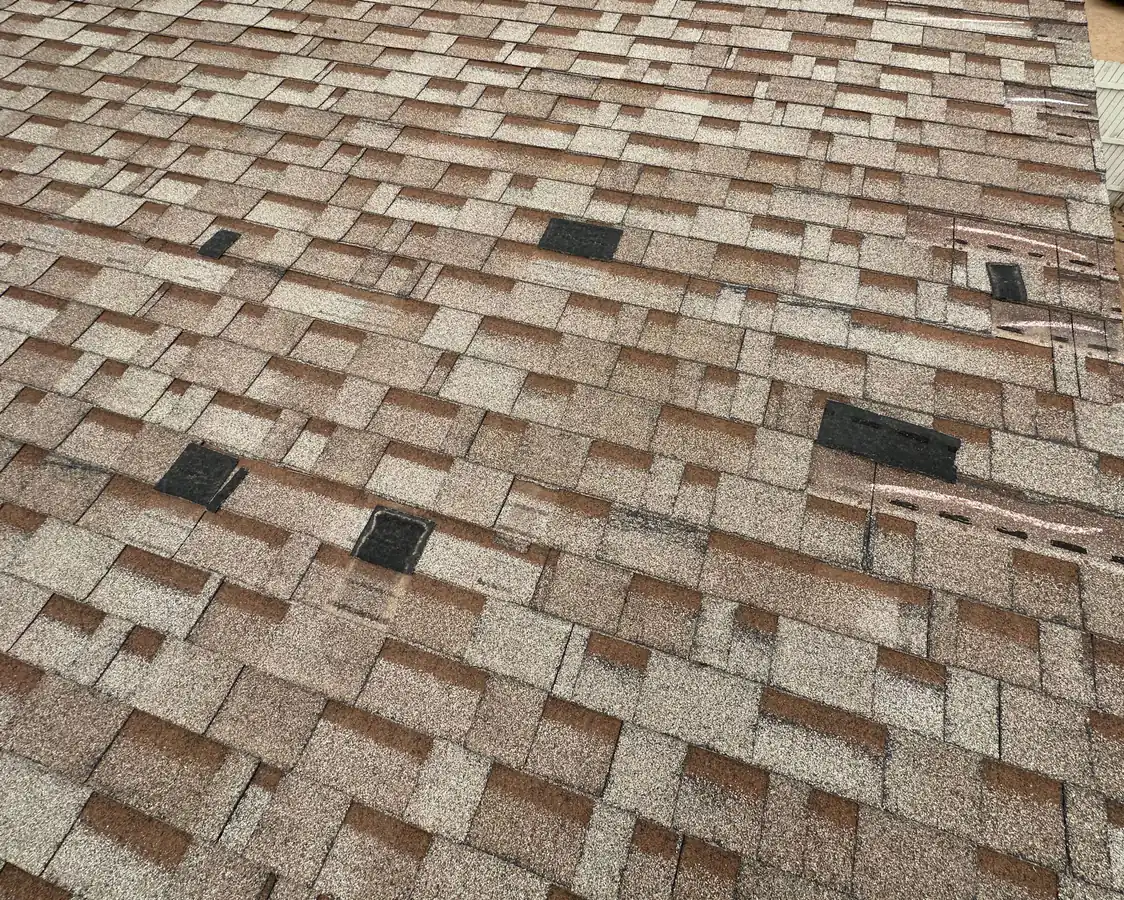
Shingles usually blow off at the edges first. Wind lifts the rake or eave course, then peels shingles up the slope. Common causes are high nails, missing starter strips, adhesive strips that never sealed because the roof was installed in cold weather, and old shingles that have lost flexibility. A home inspector checking the roof will look for lifted tabs, missing pieces, and exposed nail heads.[4] The photo on this page shows a roof where several shingles came loose in one wind event.
How can you check nailing on your roof?
Checking the nailing on your own roof is hard once the shingles are on, because the nails are hidden. During a replacement, you can ask the crew lead to show you a lifted shingle on the first few courses. After a wind event, a roofer can lift a few tabs and see where the nails are. If missing shingles show nails above the nailing zone, that points to installation rather than wind strength alone. Please stay off the roof and leave this to a pro; see our roof safety guide.
What should a high-wind roofing bid include?
A high-wind roofing bid should state the shingle's wind classification, the number of nails per shingle, the starter product at eaves and rakes, drip edge fastening, and whether the deck will be renailed with ring-shank nails. In Florida and other hurricane areas, it should also refer to local code and product approval rules. Get these details in writing, since they are hard to verify after the roof is finished.
Rather talk to someone? Request a callback
Leave your name and number and a local roofing contractor will call you back about a free estimate and inspection. Available to homeowners in our service markets.
- A local contractor calls you. They confirm your address and a time that works.
- They inspect your roof. Free, in person, no obligation.
- You get a written price. You decide. No pressure.
Frequently asked questions
Is six-nailing required everywhere?
No. Code requires at least four nails per strip shingle unless the manufacturer requires more. Many manufacturers require six nails for high-wind ratings or steep slopes.
Can a roofer use staples on shingles?
The current IRC lists roofing nails, not staples, as the fastener for asphalt shingles. Check local code if your area has amendments.
Why did my new shingles lift in the first storm?
New shingles may not have sealed yet, especially if installed in cool weather. High nails or a missing starter strip can also cause early blow-offs.
See 2026 roof replacement cost in your city →
Sources
- 2021 International Residential Code, Chapter 9: Roof Assemblies. codes.iccsafe.org/content/IRC2021P2/chapter-9-roof-assemblies
- ASTM D7158: Wind Resistance of Asphalt Shingles (Uplift Force Method). store.astm.org/d7158_d7158m-20.html
- IBHS: FORTIFIED Roof Endorsements. fortifiedhome.org/fortified-roof-endorsements/
- InterNACHI: Roof Inspection. www.nachi.org/roof-inspection.htm
Sources checked November 4, 2026. Estimates are not quotes. Roofing, insurance, and legal details vary. Confirm with your contractor, insurer, or attorney.