What is drip edge and why is it required?
Last updated · Codes, permits & licensing
Short answer: Drip edge is a bent strip of metal installed along the eaves and rakes of a roof. It directs water off the roof edge and away from the fascia, supports the edge shingles, and blocks wind-driven rain and pests. For asphalt shingle roofs, the residential code requires it at both eaves and rakes with specific overlaps and fastening.[1]
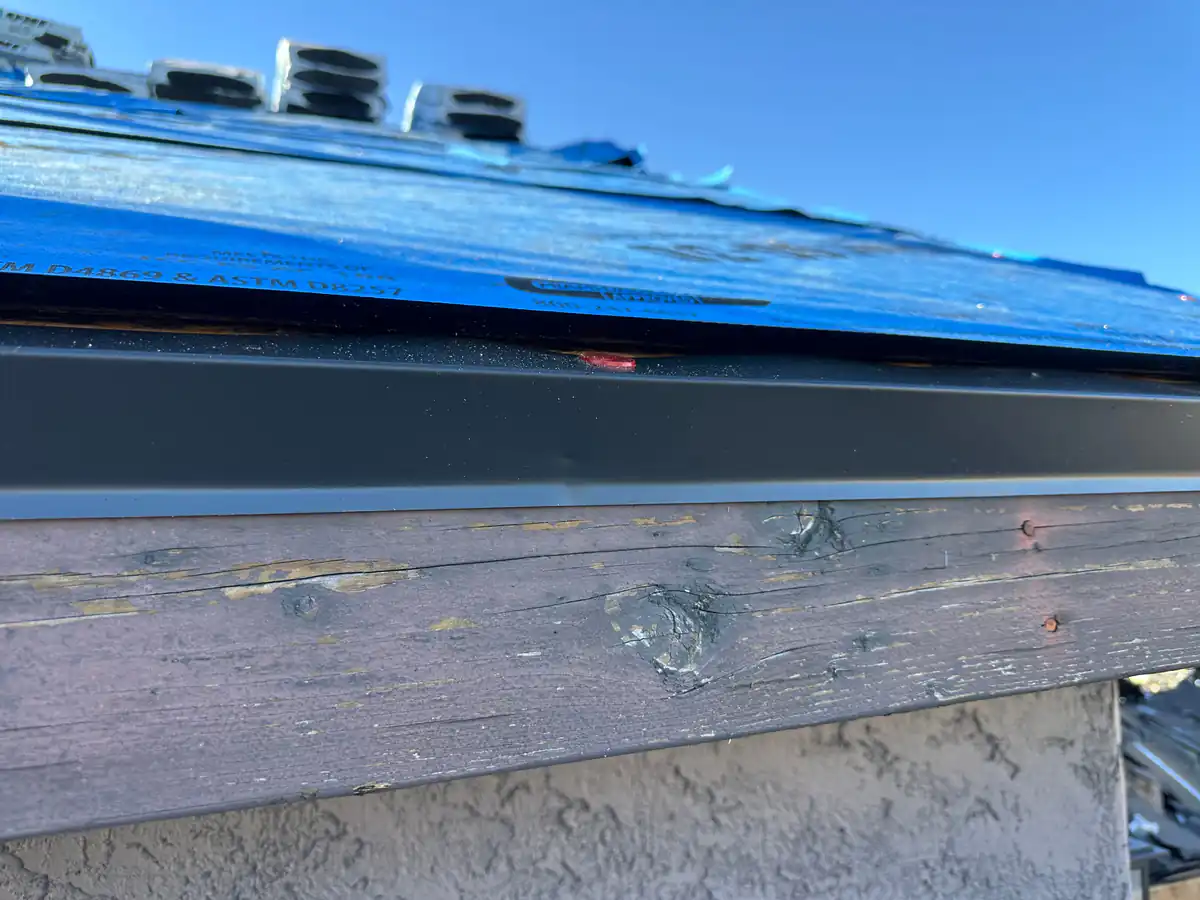
What does drip edge do for a roof?
Water clings to surfaces, so without drip edge it curls around the bottom of the roof deck and runs down the fascia, soaking into the end grain of the sheathing and the top of the fascia board. Drip edge provides a clean break that throws the water outward into the gutter. It also stiffens the roof edge so shingles do not sag over the gap, covers the gap between the deck and fascia where insects and small animals might enter, and helps hold the edge against wind.
What does the code require for drip edge?
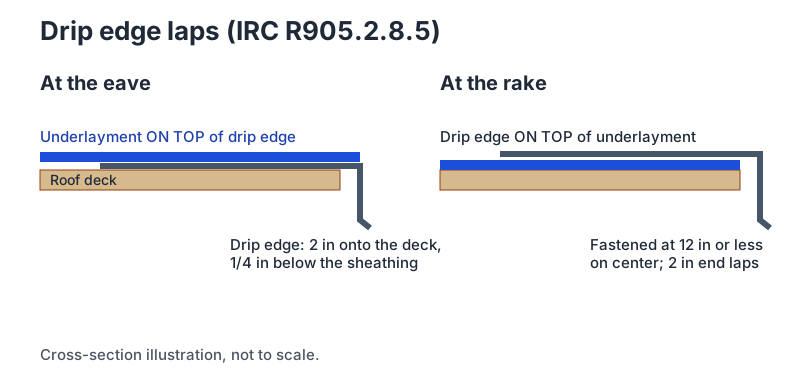
Section R905.2.8.5 of the International Residential Code requires drip edge at eaves and rake edges of asphalt shingle roofs. Adjacent pieces must overlap at least 2 inches. The drip edge must extend at least 1/4 inch below the roof sheathing and at least 2 inches back onto the roof deck, and it must be mechanically fastened to the deck at no more than 12 inches on center. Underlayment goes over the drip edge along eaves and under it along rakes.[1] Older roofs installed before this requirement often have no drip edge at all.
What are the common drip edge profiles?
Drip edge comes in a few common profiles: - Type C (L-shaped): a simple angle, often used on rakes. - Type D (T-style or "D-style"): has an extended lower flange that kicks water farther from the fascia, popular at eaves. - Gutter apron: a longer lower leg that sends water directly into the gutter, used where the gutter sits close under the roof edge. Drip edge is commonly made of painted aluminum or galvanized steel and comes in colors to match trim. The right profile depends on the gutter position and fascia layout.
Why do the laps at eaves and rakes differ?
At the eave, water flows down the underlayment and off the edge, so the underlayment must lie on top of the drip edge to shed water onto it. At the rake, water runs parallel to the edge, and wind can push rain sideways under it, so the drip edge goes over the underlayment to shield its edge. Mixing these up is a frequent defect and is easy to verify during installation.
How does drip edge help in high winds?
Edges and corners carry the highest wind uplift on a roof. The FORTIFIED Roof standard from the Insurance Institute for Business and Home Safety calls for heavier drip edge fastened at closer spacing than the code minimum, along with a sealed roof deck, to keep wind from lifting the edge.[3] Even if you are not seeking a FORTIFIED designation, asking for tighter fastening at the edges is a modest upgrade.
Should drip edge be replaced with a new roof?
Yes, in nearly all cases. Old drip edge is often bent, painted over, or the wrong profile, and reusing it makes it hard to get the laps right with new underlayment. A home inspector who sees missing drip edge or water staining on fascia boards will typically flag it.[2] Drip edge is inexpensive per foot compared with the fascia repairs it prevents.
What should a bid say about drip edge?
A clear bid lists drip edge at eaves and rakes, the profile, material, color, and footage. Ask whether the fascia will be inspected and repaired when the old drip edge comes off, and how gutters will be handled. If a contractor proposes to skip drip edge or install it only at the eaves, ask why, because that would not meet the code requirement for asphalt shingles.
Rather talk to someone? Request a callback
Leave your name and number and a local roofing contractor will call you back about a free estimate and inspection. Available to homeowners in our service markets.
- A local contractor calls you. They confirm your address and a time that works.
- They inspect your roof. Free, in person, no obligation.
- You get a written price. You decide. No pressure.
Frequently asked questions
Does drip edge go under or over the gutter?
The drip edge or gutter apron sits on the roof edge above the gutter so water drips into it. The gutter hangs on the fascia below.
Can drip edge be added to an existing roof?
It can be slipped under the first course on some roofs, but it is much easier and more reliable during a replacement.
Is drip edge required on metal or tile roofs?
Those systems use their own edge trims and requirements set by the manufacturer and code sections for that material.
See 2026 roof replacement cost in your city →
Sources
- 2021 International Residential Code, Chapter 9: Roof Assemblies. codes.iccsafe.org/content/IRC2021P2/chapter-9-roof-assemblies
- InterNACHI: Roof Inspection. www.nachi.org/roof-inspection.htm
- IBHS: FORTIFIED Roof Endorsements. fortifiedhome.org/fortified-roof-endorsements/
Sources checked November 4, 2026. Estimates are not quotes. Roofing, insurance, and legal details vary. Confirm with your contractor, insurer, or attorney.