Ladder safety for homeowners: Setup, angle, and climbing
Last updated · Roof & ladder safety
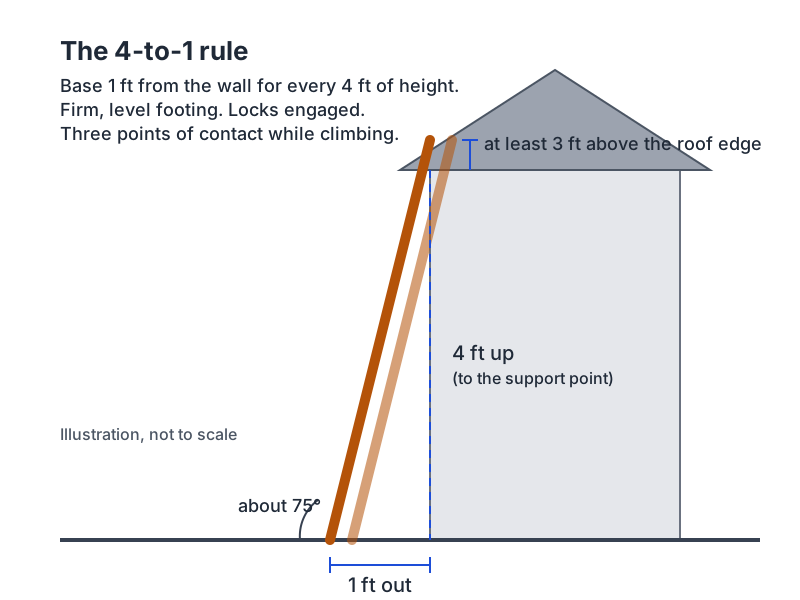
Short answer: To use an extension ladder safely, set it on firm, level ground with the base one foot out for every four feet of height to the support point, extend it at least 3 feet above the roof edge, lock it, and keep three points of contact while you climb. Inspect it first and never overreach.[1]
How do you pick the right ladder for roof access?
Picking the right ladder starts with length and duty rating. An extension ladder must be long enough to reach the gutter line plus at least 3 feet, and remember that the overlap between sections means a 24-foot ladder does not give 24 feet of working length. The duty rating on the side label tells you how much weight the ladder is built to carry, counting you, your clothes, and your tools. Under the ANSI A14 ladder standards maintained by the American Ladder Institute, ratings run from Type III light duty at 200 pounds up to Type IAA special duty at 375 pounds.[3] Fiberglass rails are the better choice anywhere near electrical lines, because aluminum conducts.
What should you check before you climb?
Check the ladder every time before you climb. OSHA's ladder guidance says a damaged ladder should be taken out of service until it is repaired or thrown away.[1] Look for: - Bent, cracked, or split rails and rungs. - Missing or worn rubber feet. - Rung locks and the rope and pulley that do not move freely. - Mud, oil, paint, or wet leaves on the rungs or your shoe soles. Then look up. Overhead power lines and the service drop to your house are a serious hazard; keep the ladder and anything you carry well clear of them.
What is the 4-to-1 rule for ladder angle?
The 4-to-1 rule sets the base of the ladder one foot away from the wall for every four feet of height to where the ladder rests. OSHA describes it as placing the base a quarter of the working length from the wall.[1] That works out to roughly 75 degrees. Getting the angle wrong matters: NIOSH reports that in about 40 percent of ladder injury cases the cause is the ladder base sliding out because of an incorrect setup angle.[2] A quick check is to stand at the base with your toes at the rails and arms straight out; your palms should reach the rung at shoulder height. The free NIOSH Ladder Safety app also measures the angle with your phone.
How do you get level, stable footing?
A ladder should only stand on a stable, level surface unless it is secured against movement.[1] Soft lawn, gravel, and sloped driveways are the usual problems. Use a ladder leveler made for your model rather than shims, boards, or bricks, and never set a ladder on boxes or buckets to gain height. On soft ground, a wide base pad helps keep the feet from sinking unevenly. Avoid setting up in front of a door that someone could open, and keep kids, pets, and cars away from the base.
Why must the ladder extend 3 feet above the roof edge?
When you use a ladder to reach a roof, OSHA's rule is that its side rails extend at least 3 feet above the landing.[4] Those extra rungs give you something to hold while you step on and off the roof, which is the most dangerous moment of the climb. Rest the rails against a solid surface, not a flimsy gutter; a stand-off stabilizer bridges the gutter and spreads the load. Tie the top of the ladder off to the structure if you can, and make sure both rung locks are fully engaged before you climb.
How do you climb and work on a ladder safely?
Face the ladder and keep three points of contact at all times: two hands and one foot, or two feet and one hand.[1] Keep your belt buckle between the rails, and move the ladder instead of leaning to the side. Do not stand on the top three rungs of an extension ladder. Carry tools in a belt or raise them with a rope rather than in your hands. Overreaching, carrying objects, and pushing or pulling hard while on a ladder are among the improper-use causes NIOSH lists for ladder falls.[2] Climb only when someone else is home and knows you are up there.
When should you skip the ladder entirely?
Skip the ladder entirely in wind, rain, frost, or failing light, and if you feel tired, dizzy, or rushed. If you only want to know whether storm damage occurred, binoculars or a zoomed phone photo from the ground answers a lot. For anything more, a free roof inspection lets a trained crew with proper fall protection do the looking, and you can review their photos from the ground. See what to expect at a roof inspection for how that works.
Rather talk to someone? Request a callback
Leave your name and number and a local roofing contractor will call you back about a free estimate and inspection. Available to homeowners in our service markets.
- A local contractor calls you. They confirm your address and a time that works.
- They inspect your roof. Free, in person, no obligation.
- You get a written price. You decide. No pressure.
Frequently asked questions
What angle should an extension ladder be at?
About 75 degrees, which is the 4-to-1 rule: one foot out from the wall for every four feet of height to the support point.
Can I lean a ladder against my gutter?
Gutters are not built to carry that load. Use a stand-off stabilizer that rests on the wall or roof instead.
How far should a ladder stick out above the roof?
At least 3 feet above the edge, so you have a handhold while stepping on and off.
See 2026 roof replacement cost in your city →
Sources
- OSHA Quick Card: Portable Ladder Safety. www.osha.gov/sites/default/files/publications/portable_ladder_qc.pdf
- CDC/NIOSH: Ladder Safety. www.cdc.gov/niosh/falls/ladder/index.html
- American Ladder Institute: ANSI A14 Standards. www.americanladderinstitute.org/page/A14Standards
- OSHA 29 CFR 1926.1053: Ladders. www.osha.gov/laws-regs/regulations/standardnumber/1926/1926.1053
Sources checked November 4, 2026. Estimates are not quotes. Roofing, insurance, and legal details vary. Confirm with your contractor, insurer, or attorney.