Roof safety gear: Harnesses, anchors, and PPE
Last updated · Roof & ladder safety
Short answer: Safe roof work relies on a personal fall arrest system: a full-body harness, a lanyard or rope grab on a lifeline, and an anchor fastened into the roof framing. Add gloves, eye protection, and a hard hat for overhead hazards. OSHA requires fall protection for professionals working six feet or more above a lower level.[4]
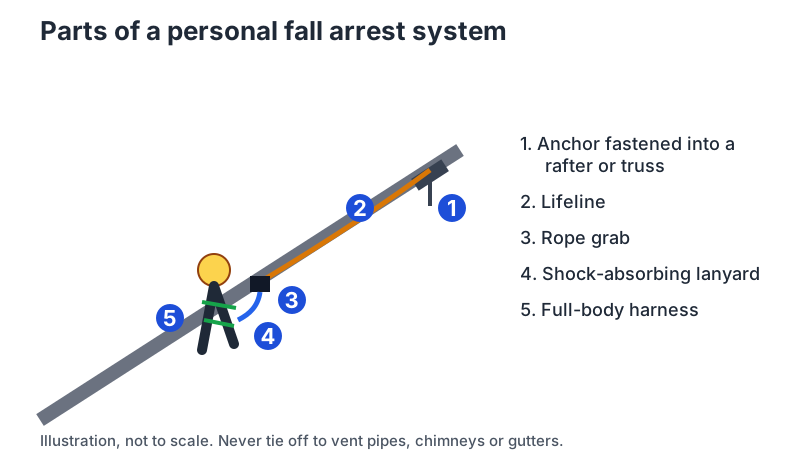
What does a personal fall arrest system include?
A personal fall arrest system has three parts that must work together. The full-body harness spreads fall forces across your thighs, pelvis, chest, and shoulders. The connector, usually a shock-absorbing lanyard or a rope grab on a vertical lifeline, links you to the anchor and limits the jolt. The anchor is fastened to the structure. OSHA's criteria say body belts are not acceptable as part of a fall arrest system, and that a system must limit free fall to 6 feet and keep the user from hitting a lower level.[1]
How strong does a roof anchor need to be?
Anchors carry enormous loads in a fall. OSHA requires anchorages for fall arrest to support at least 5,000 pounds per person attached, or to be designed with a safety factor of at least two under a qualified person's supervision.[1] On a house, that usually means a manufactured roof anchor screwed or nailed through the sheathing into a rafter or truss exactly as the maker specifies, not a nail into plywood alone. Permanent anchors can be left in place under the shingles for future work. Vent pipes, chimneys, and gutters are never anchors.
Why is a rescue plan part of fall protection?
A rescue plan matters because a harness only stops the fall. Someone hanging in a harness needs to be brought down quickly, and OSHA requires employers to provide for prompt rescue of anyone who falls.[1] For a homeowner, that means never working alone, keeping a phone on you, and having a second person on the ground who knows how to reach you. If you cannot arrange that, the job is better left to a crew that has.
When does OSHA require fall protection for roofers?
OSHA requires fall protection for workers on residential construction at six feet or more above a lower level, using guardrails, safety nets, or personal fall arrest systems, with alternatives only when the employer can show those are infeasible.[4] Those rules apply to employers, not homeowners working on their own houses. Still, it is reasonable to ask any roofer you hire how their crew will be protected, because a contractor who plans for safety is usually careful in other ways too.
Which gloves work best for roof work?
For roof work, choose gloves with a coated, grippy palm. Coated work gloves help you grip ladder rails and protect against sharp metal flashing, nails, and abrasive shingles. Avoid thick, loose gloves that make it hard to feel a rung. In summer, gloves also protect your hands from shingles hot enough to burn.
Do you need eye protection and a hard hat?
Eye protection is worth wearing whenever you cut, pry, nail, or sweep debris, and on bright days for glare. OSHA requires employers to provide eye and face protection when work exposes workers to flying particles, and that protection must meet the ANSI Z87.1 standard.[3] A hard hat protects against falling objects and bumps on overhangs or in the attic; OSHA requires head protection meeting ANSI Z89.1 where workers face those hazards.[2] Homeowners should wear one if anyone is working above them or they will be under eaves.
Is it worth buying this gear for one job?
A harness kit, rope, and anchor can cost more than a professional inspection or minor repair, and they only protect you if they are installed and used correctly. For a one-time look after a storm, a free roof inspection by an equipped crew is usually the safer and cheaper route. If you do plan regular roof maintenance, buy a complete kit, read the instructions, and practice on a low roof. See ladder safety for homeowners and the right shoes for roof work.
Rather talk to someone? Request a callback
Leave your name and number and a local roofing contractor will call you back about a free estimate and inspection. Available to homeowners in our service markets.
- A local contractor calls you. They confirm your address and a time that works.
- They inspect your roof. Free, in person, no obligation.
- You get a written price. You decide. No pressure.
Frequently asked questions
Can I tie off to my chimney or vent pipe?
No. Neither is designed to hold fall forces. Use a rated roof anchor fastened into the framing.
Do homeowners have to follow OSHA rules?
OSHA rules apply to employers and their workers, not to homeowners working on their own homes. They are still sound guidance.
How long can a harness be used?
Follow the manufacturer's inspection and retirement guidance, and retire any harness that has arrested a fall or shows damage.
See 2026 roof replacement cost in your city →
Sources
- OSHA 29 CFR 1926.502: Fall protection systems criteria and practices. www.osha.gov/laws-regs/regulations/standardnumber/1926/1926.502
- OSHA 29 CFR 1926.100: Head protection. www.osha.gov/laws-regs/regulations/standardnumber/1926/1926.100
- OSHA 29 CFR 1926.102: Eye and face protection. www.osha.gov/laws-regs/regulations/standardnumber/1926/1926.102
- OSHA 29 CFR 1926.501: Duty to have fall protection. www.osha.gov/laws-regs/regulations/standardnumber/1926/1926.501
Sources checked November 4, 2026. Estimates are not quotes. Roofing, insurance, and legal details vary. Confirm with your contractor, insurer, or attorney.